

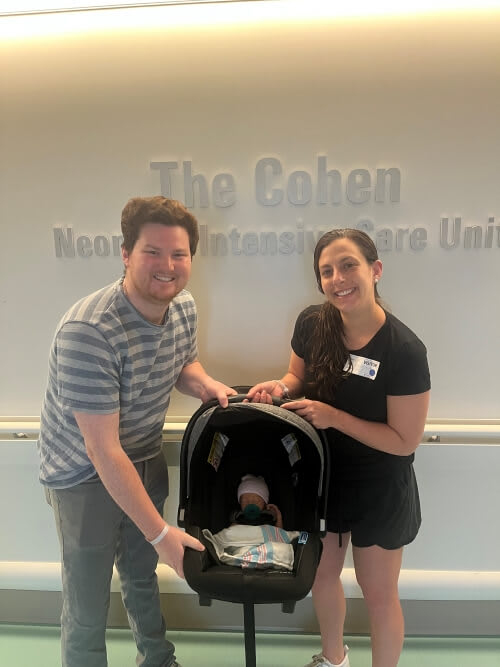
When Ali Warshavsky was 34 weeks pregnant in the spring of 2025, she went to see her OB-GYN for a regular checkup – which quickly took a dramatic turn. “I felt fine, but as they were taking my vitals, they were like – ‘You need to go to the hospital immediately. Your blood pressure is really, really high and you’re exhibiting signs of preeclampsia,’” Warshavsky recounted, referring to the serious condition that can occur during pregnancy.
WHAT IS PREECLAMPSIA?
Preeclampsia affects all organs in the body and usually develops after 20 weeks of pregnancy, according to the American College of Obstetricians & Gynecologists. It can lead to serious complications and can even affect blood supply to the placenta.
“I was definitely concerned, but I remember texting my co-worker, saying ‘Oh, I’ll be back in two hours, they just want to monitor me,’” Warshavsky said.
But when she arrived at Stamford Hospital, Warshavsky was immediately sent to the Labor & Delivery Unit, where her blood pressure was not improving. The nurses told her that she should call her husband – because her care team needed to induce labor that day for the safety of both Warshavsky and her son. Warshavsky was overwhelmed; she and her husband hadn’t packed a “go-bag” for the hospital yet, they didn’t have a pediatrician selected, and they had just moved into a new home.
“I started crying because I was in shock – but the nurses were amazing – they kept telling me it was OK to be upset and comforting me,” Warshavsky said.
Warshavsky delivered her son, Brooks, the next afternoon. He weighed just about 4 pounds and was not breathing well.
“You think you’re going to have this magical moment where they lay your kid on your chest and you get to meet them … Instead, I gave him a kiss and they had to take him to the NICU right away,” she recalled.
Warshavsky wasn’t aware that Stamford Hospital had a level III NICU, but upon Brooks’ admission, she was relieved to learn he was in such good hands and wouldn’t need to be transported anywhere.
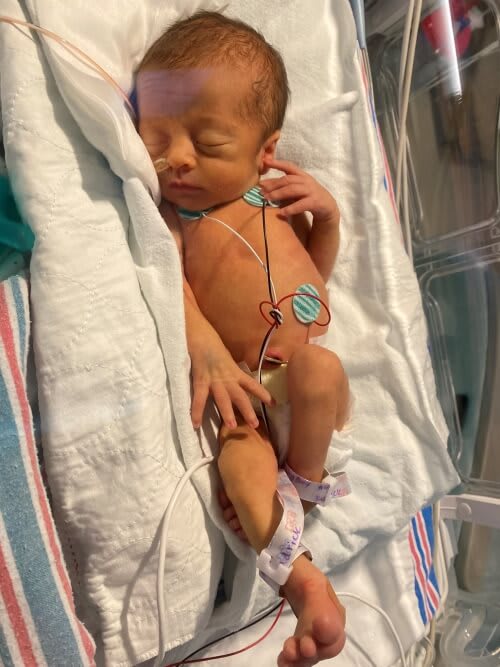
AN UNEXPECTED STAY AT THE NICU
As soon as Warshavsky was no longer exhibiting symptoms of preeclampsia, the nurses brought her to the NICU so she could spend time with Brooks. As she continued to recover at Stamford Hospital, she and her husband were able to spend time at the NICU and monitor their son’s progress. Life as a NICU parent became harder when Warshavsky was discharged home.
“I remember thinking, I’m leaving my baby at the hospital and I’m going home … I really, really appreciated the NICU team even more when I went home – they just understood what we needed,” Warshavsky said. “I remember one day, one of the nurses who was helping Brooks learn how to eat, paused what she was doing for a minute to just give me a hug – and that’s what I needed in that moment.”
Brooks’ care team always waited for Warshavsky and her husband, Connor Dowling, to be there for care times so they could change Brooks’ diapers and feed him. One NICU nurse reminded Warshavsky to try to get outside each day, and to focus on prioritizing her mental health during this difficult time.
As soon as Warshavsky was no longer exhibiting symptoms of preeclampsia, the nurses brought her to the NICU so she could spend time with Brooks. As she continued to recover at Stamford Hospital, she and her husband were able to spend time at the NICU and monitor their son’s progress. Life as a NICU parent became harder when Warshavsky was discharged home.
“I remember thinking, I’m leaving my baby at the hospital and I’m going home … I really, really appreciated the NICU team even more when I went home – they just understood what we needed,” Warshavsky said. “I remember one day, one of the nurses who was helping Brooks learn how to eat, paused what she was doing for a minute to just give me a hug – and that’s what I needed in that moment.”
Brooks’ care team always waited for Warshavsky and her husband, Connor Dowling, to be there for care times so they could change Brooks’ diapers and feed him. One NICU nurse reminded Warshavsky to try to get outside each day, and to focus on prioritizing her mental health during this difficult time.
GRADUATING FROM THE NICU
Taking a new baby home from the hospital is overwhelming for any new parent, but bringing home a 4-pound baby who had a 10-day long stay in the NICU was a lot for the Warshavsky and Dowling to consider.
Taking a new baby home from the hospital is overwhelming for any new parent, but bringing home a 4-pound baby who had a 10-day long stay in the NICU was a lot for the Warshavsky and Dowling to consider.
That’s why they were so thrilled to hear that Stamford Hospital offers a transitional room for its NICU parents, where they can stay with their baby overnight, at the Hospital, under regular monitoring. That way, parents feel more comfortable and prepared when they are able to take their child home.
“Dr. Ciannaella, Stamford Health’s director of neonatology, said that he wanted to be extra careful before Brooks went home – he wanted to make sure he was taking a bottle at every feed,” Warshavsky said. “He mentioned the transitional room – and we immediately said of course! We stayed there overnight, and the nurse just came in to take Brooks’ vitals – it was our first night as ‘real parents,’ – we didn’t sleep at all! We did every diaper change and every bottle feed.”
The next day the new parents were able to bring Brooks home. Today, he is thriving.
“He loves to eat,” Warshavsky said, remembering there was a time when they had to feed him every hour so he’d gain weight. “He’s already eating solids – he looks like a normal 5-month-old, you’d never know about all that he went through. He looks completely different.”
“Dr. Ciannaella, Stamford Health’s director of neonatology, said that he wanted to be extra careful before Brooks went home – he wanted to make sure he was taking a bottle at every feed,” Warshavsky said. “He mentioned the transitional room – and we immediately said of course! We stayed there overnight, and the nurse just came in to take Brooks’ vitals – it was our first night as ‘real parents,’ – we didn’t sleep at all! We did every diaper change and every bottle feed.”
The next day the new parents were able to bring Brooks home. Today, he is thriving.
“He loves to eat,” Warshavsky said, remembering there was a time when they had to feed him every hour so he’d gain weight. “He’s already eating solids – he looks like a normal 5-month-old, you’d never know about all that he went through. He looks completely different.”

Reflecting on Brooks’ NICU stay, the family is so grateful for the care that they received.
“They (the NICU team) made such an impact on our lives and got us through that challenging time. We’re so appreciative,” she said.
“They (the NICU team) made such an impact on our lives and got us through that challenging time. We’re so appreciative,” she said.