
?h=750&iar=0&w=563)
On December 8, Michael Zarrilli had returned home from a typical Monday at work. As he made his way to the bathroom to take a shower, the 29-year-old suddenly lost control of his hand. “I dropped my phone, and when I went to pick it up, I had no balance and fell,” he said. “I lost control of my entire left side and had no idea what was happening.”
Zarrilli quickly called his girlfriend at the time, who was a nurse. “When she heard how I was speaking and that I was stuck on the ground, she dialed 9-1-1, because she knew it was likely a stroke,” he recalled.
As the ambulance made its way to Stamford Hospital, recognized by the American Heart Association for its commitment to high-quality stroke care, medics performed a neurological assessment. “There was a team waiting for me at the hospital, and it felt like a scene out of a movie,” he said.
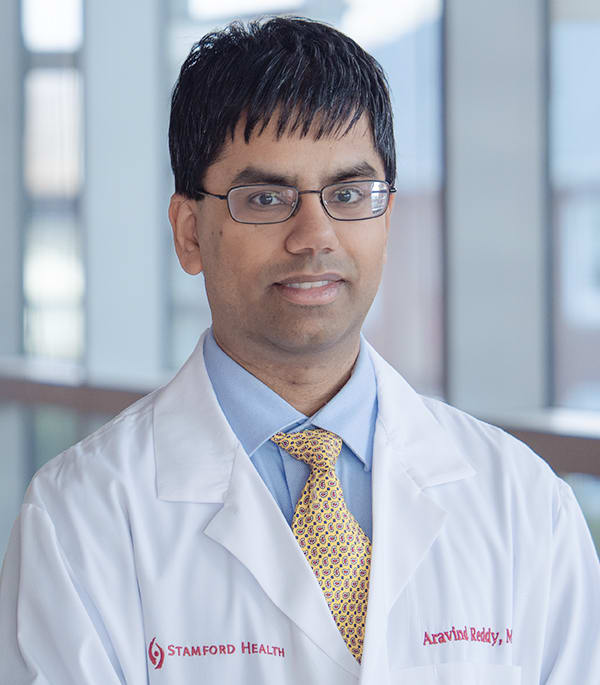
“Both Michael and the emergency medical services (EMS) team recognized his symptoms as possible stroke symptoms – that was hugely helpful,” said Dr. Aravind Reddy, the neurologist who treated Michael in the emergency department. “The EMS team called our ER to alert us, which activates not only the ER, but also neurology, radiology, and the rest of stroke support services.”
A computed tomography (CAT scan) revealed Zarrilli had a brain bleed, and he was admitted into the Intensive Care Unit (ICU). Hemorrhagic strokes, caused by a burst blood vessel in the brain, are less common but more deadly. Compared to ischemic strokes, which are caused by blood clots, hemorrhagic strokes account for 30% of all stroke deaths.
“If Michael hadn’t come to the ER right away, his bleeding could have gotten significantly worse,” noted Reddy who stressed how important it is to act quickly when experiencing any stroke symptoms. “The medications we started immediately helped to lower his blood pressure which helped to stop the bleeding.”
While it may seem like an anomaly, more and more young adults in the United States are experiencing strokes. According to research from the American Heart Association, strokes are trending down for older adults and becoming more common among those aged 15 to 49.
For Zarrilli, it was a shock that he had to come to grips with quickly. “In my head, I was like, there’s no way it’s a stroke. I’m 29 years old,” he said. “But I had high blood pressure, which I always thought was more of ‘white coat syndrome,’ where it would spike at the doctor’s office. I figured that I’m young and in shape and hypertension just wasn’t something I needed to worry about yet.”
With his family in the room, the doctors explained the urgency to lower his systolic blood pressure (the top number) down from the dangerously high reading of 214. “The team was able to keep it below 150, which was a huge help,” Zarrilli said. “The care was just awesome and everyone was on it. At that point, I felt like everything was going to be OK.”
High blood pressure is a significant risk factor for stroke, as is high cholesterol, obesity, and diabetes. Lifestyle factors such as limited physical activity, substance use (such as alcohol or tobacco), and high stress can also contribute.
Zarrilli’s hypertension led to a weakened blood vessel in his brain that eventually burst that afternoon. The hemorrhage was on the right side of the brain, which caused his left side of the body to become weak. Those warning signs make up the American Stroke Association’s BE-FAST acronym (Balance loss, eye changes, face drooping, arm weakness, speech difficulty, and time to call 911).
A few hours later, a second CAT scan showed that the bleeding thankfully had stopped. That news led his doctors to feel confident in Zarrilli’s chances of recovery and gave him the green light to begin in-hospital rehabilitation.
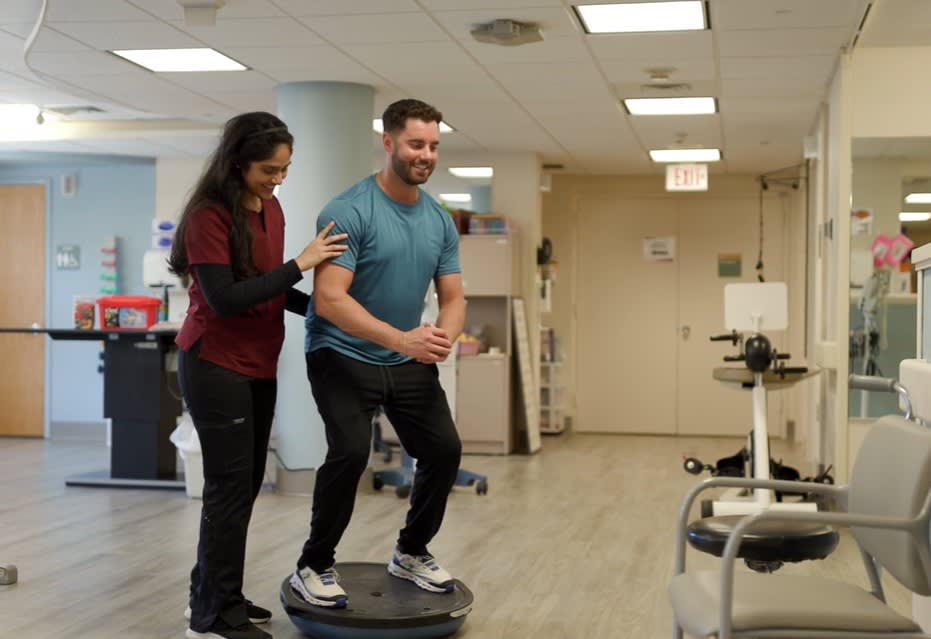
The next morning when Zarrilli tried to make it the 10 feet from his bed to the door of his room, he broke down. “My therapists immediately comforted me and reminded me that I was young and could make a great comeback,” he said. “And that’s when I just changed my mindset. I was going to give it my 100% and go as hard as I can.”
After two more days of occupational therapy (OT) and physical therapy (PT), Zarrilli was able to walk on his own. But preparing for a move out of the ICU into the Van Munching Acute Rehabilitation Unit gave him pause. “I had developed an attachment and comfortability with my nurses in the ICU, and I was nervous about leaving them,” he said.
After two more days of occupational therapy (OT) and physical therapy (PT), Zarrilli was able to walk on his own. But preparing for a move out of the ICU into the Van Munching Acute Rehabilitation Unit gave him pause. “I had developed an attachment and comfortability with my nurses in the ICU, and I was nervous about leaving them,” he said.
But, as soon as he met the nurses and rehab team that would care for him, he immediately settled in. “I went down there and I told them that I’m ready to go. I want to work hard and do this,” he remembered.
Zarrilli began the grueling work of rehabilitation for three hours each day to continue building his strength and movement with OT and PT. “It was so tiring, but every day I was getting stronger,” he said. “I felt supported by everyone and so comfortable that the team was going to help me achieve my goals. I truly believe that if I didn’t have all the therapists at Van Munching, I wouldn’t be where I am now.”
Zarrilli began the grueling work of rehabilitation for three hours each day to continue building his strength and movement with OT and PT. “It was so tiring, but every day I was getting stronger,” he said. “I felt supported by everyone and so comfortable that the team was going to help me achieve my goals. I truly believe that if I didn’t have all the therapists at Van Munching, I wouldn’t be where I am now.”
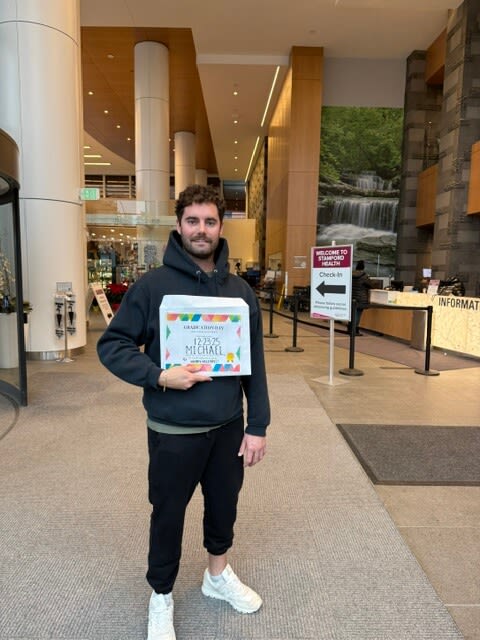
Zarrilli was discharged from inpatient rehabilitation two weeks later. “I had regained 85% of everything and was ready to start outpatient rehab,” he said. Then, after working with the therapists at Tully Health Center for a few weeks, Zarrilli graduated from physical therapy.
Less than four months later, he continues to work with OT to strengthen his hand and fine motor skills. A follow-up scan showed no signs of the bleed, and he monitors his blood pressure every day and takes medicine.
“I feel like this is a world record of stroke recovery,” marveled Zarrilli, who said he is about 90-95% back to normal. “Overall, everyone from the ICU to Van Munching to outpatient has been nothing but spectacular and supportive. They made it an easier process for me both mentally and physically, and I couldn’t thank them all enough for everything.”
Less than four months later, he continues to work with OT to strengthen his hand and fine motor skills. A follow-up scan showed no signs of the bleed, and he monitors his blood pressure every day and takes medicine.
“I feel like this is a world record of stroke recovery,” marveled Zarrilli, who said he is about 90-95% back to normal. “Overall, everyone from the ICU to Van Munching to outpatient has been nothing but spectacular and supportive. They made it an easier process for me both mentally and physically, and I couldn’t thank them all enough for everything.”